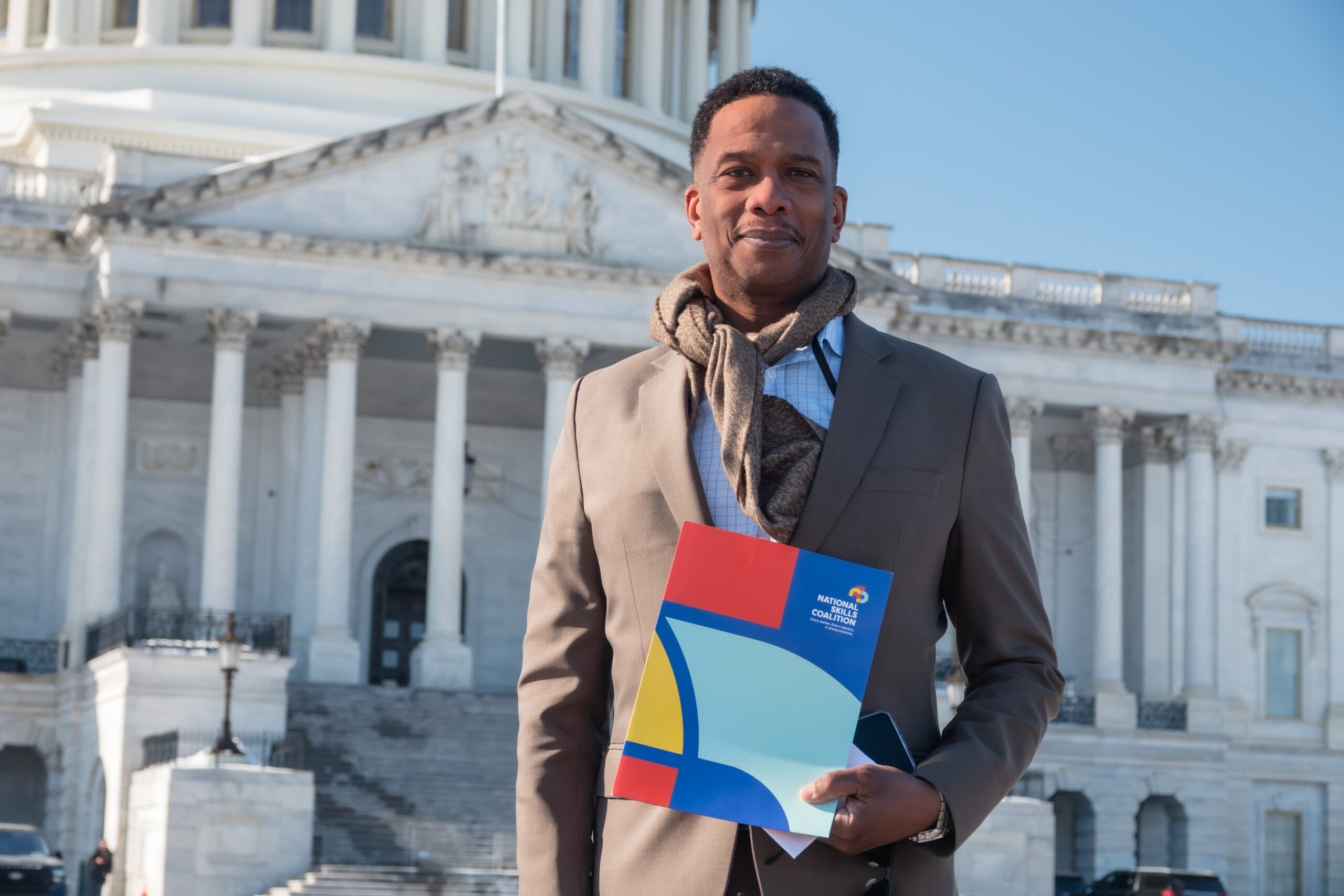
Last week’s Skills Summit opened at a moment when few in our field could ignore the stakes. Across the country, workforce advocates, employers, students, and workers are navigating political uncertainty, shifting federal priorities, and rapid economic change – all while continuing the work of connecting people to opportunity and helping local businesses grow stronger and more competitive. It was against that backdrop that this year’s Summit brought together 250 workforce policy champions in Washington, D.C. on February 5 & 6 – not simply for an advocacy day, but as a call to action.
During this pivotal time on Capitol Hill before key funding and implementation decisions are made, participants gathered to learn and connect. Most importantly, they came to lead nearly 100 meetings with lawmakers to influence the federal policies that shape opportunity in their communities. On day one, they arrived on Capitol Hill determined to protect investments workers and businesses rely on. On day two, they focused on co-creating a more fair and prosperous future.
In her opening remarks, National Skills Coalition CEO Brooke DeRenzis grounded the participants in the realities facing communities nationwide. She acknowledged the climate shaped by harmful policies toward immigrants, rhetoric that diminishes the country’s diversity, and economic pressures that deepen hardship for working families.
She went on to name – and reject – the persistent narrative that our workforce system exists primarily as a “second chance” for people who have “fallen short” in school or work. That framing, DeRenzis argued, “diminishes working-class careers, overlooks talent, and ignores structural barriers hold people back.” Saying “it’s time to flip the script,” DeRenzis told advocates that “Workforce development should be a first-choice investment that unlocks potential, centers dignity and equity, and helps workers and local businesses adapt to and benefit from technological and economic change.”
That call was echoed in conversation with Sarah Saadian, Senior Vice President of Public Policy and Campaigns at National Council of Nonprofits, who urged advocates to engage policymakers across differences and speak directly to the impact of their work. Conversations with elected officials, she noted, are never wasted saying, “Even when you don’t think they’ll be on your side, show them the work you’re doing. Move them to neutral. I promise they’ll be impacted by what they see.” At the same time, she cautioned advocates about the administration’s attempts to undermine the voice of the civil sector and urged us to not “comply in advance” but to use new tools to commit to their missions.
Click for photos of the Skills Summit
This year, National Skills Coalition presented the Founder’s Circle Award to Abby Snay, Deputy Secretary for Workforce Strategy at the California Labor and Workforce Development Agency. Established by NSC’s Board in honor of Founding CEO Andy Van Kleunen, the award recognizes leaders who have leveraged their influence to advance inclusive skills policy and expand opportunities for workers and businesses. Snay’s career — spanning transformative state leadership, more than three decades guiding Jewish Vocational Service into a national model, and sustained partnership with NSC through board service and collaborative initiatives — reflects a deep commitment to expanding access to high-quality training and economic mobility.
The Summit also recognized the power of partnership through a presentation of the Dr. Alma Salazar Bridge Builder Award, given this year to Jamal Jessie, Manager of Community and Workforce Development at Google Data Centers. Established by the NSC Board in 2021 to honor the legacy of Alma Salazar — a leader known for uniting uncommon allies around inclusive skills policy — the award celebrates members of NSC’s network who embody that same commitment to collaboration. Jessie’s work building partnerships across the Southeast reflects his dedication to expanding opportunity through shared solutions. By connecting employers, community organizations, and policymakers so they can strengthen talent pipelines and advance equitable workforce strategies, his work embodies the bridge-building spirit of the award.
While the first day of Capitol Hill advocacy focused on protecting the workforce investments and policies communities rely on today, the Summit’s interactive sessions on the second day looked ahead by asking participants to help shape what comes next. In facilitated small groups/listening sessions, participants learned about a new and soon-to-be-launched NSC national initiative focused on creating a new workforce vision. Attendees reacted to draft principles and reflected on how a forward-looking vision resonates with their real, on-the-ground experience. The conversations brought up themes, tensions, and challenges that will inform our development of a bold national policy agenda. A special thank you to our friends at LinkedIn for sponsoring an energizing reception with workforce, education, and business leaders to celebrate this new initiative.
Mainstage conversations explored the political realities shaping workforce policy and the shared priorities that unite our field. In Working People and Our Nation’s Future, panelists Taylor Jo Isenberg, Executive Director at Economic Security Project; Michael Strain, Director of Economic Policy Studies at American Enterprise Institute, examined how shifting political alignments and a consequential election year are redefining expectations for policymakers — underscoring the need for advocates to remain grounded in the lived experiences of workers while advancing bold, durable policy solutions. Different Voices, Shared Vision picked up that alignment theme. Jamal Jessie and Lynne Hamblin, advocate for adult education; connected employer and worker perspectives and highlighted areas of agreement around skills, training, and credentials. Together, the discussions drove home a central takeaway of the Summit. Progress depends not on choosing between viewpoints, but on finding shared goals and building the strategic coalitions that are strong enough to move them forward.
The Summit closed with Real People, Real Progress, a conversation featuring Caitlyn Brazill, President, Per Scholas; Mauricio Garcia, Senior Vice President, Programs, Unidos US; and Jacob I. Hannah, Coalfield Development Corp. These three dynamic guests reflected on what it means to build workforce systems that center dignity, opportunity, and local insight – from expanding access to technology-driven careers to rebuilding trust across institutions and addressing affordability, immigration, and job quality as interconnected economic realities. The discussion was truly inspirational. Jacob Hannah urged us to “Fall in love with the problem so we can turn it into power.” Mauricio Garcia reminded us that our work is about bringing dignity back to a job, so everyone “can go home and have a carne asada with your family”. Caitlyn Brazill urged us to be bold and create lasting impacts that will outlast administrations – a charge that echoed throughout the room as advocates prepared to carry lessons home and translate them into action.
The 2026 Skills Summit made clear that this moment calls for both vigilance and vision. That means protecting existing investments workers and businesses depend on, while organizing to build what comes next. The work does not end when our coalition leaves Washington. The path forward is sustained engagement: following up with policymakers, hosting site visits that show skills in action, lifting up local voices, and sharing stories that connect community impact to national policy.
Throughout the year, advocates will continue to engage in network calls, policy briefings, and key federal milestones — from appropriations debates to Workforce Pell implementation — ensuring workforce issues remain on the agenda. Stay tuned!
