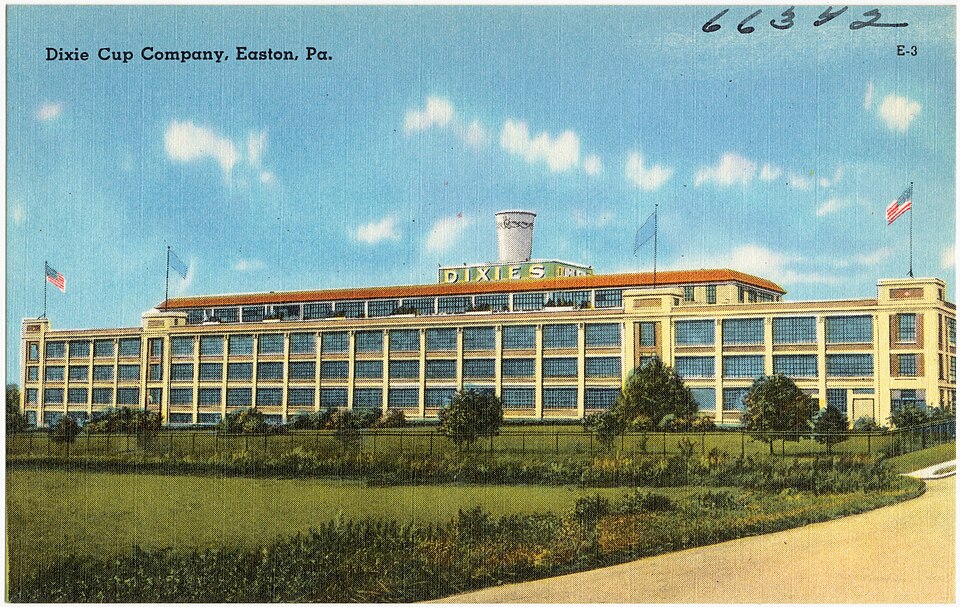
Driving through my hometown of Easton, PA this summer, I noticed something missing: the 50,000-gallon Dixie Cup that was part of the skyline for my entire life was gone. The Dixie Cup (and the factory it capped) were a symbol of the city’s economic ups and downs. Built in 1921, the factory once meant good blue-collar careers. But it sat vacant for over four decades after deindustrialization changed the region’s fortunes and job market. As the city reinvents its economy, the Dixie factory is being redeveloped into a mixed-use complex, bringing a mix of hope and anxiety to a community where promises of economic renewal have been made before.
This experience isn’t unique to my hometown. Waves of economic change often arrive with a promise: everyone will benefit. Working people have heard that promise before, only to see it broken. That history is why concerns about AI go beyond technology. The future of work will be shaped not only by what AI can do, but by whether working people trust that this time, they will share in the opportunities and gains of economic change.
From Rust Belt communities like the one I grew up in to coal country communities in Middle Appalachia, economic transitions have often left people to watch jobs disappear and opportunities move elsewhere. Meanwhile, major cities from New York to Los Angeles experienced waves of urban revitalization and economic growth, but many residents watched new skylines emerge that had little connection to their everyday lives. While the overall economy grew, many working people were left out and had to navigate change largely on their own. So, it’s not surprising that only 39% of lower-income Americans say it is still possible to achieve success in the U.S. through hard work and determination (compared to 64% of upper-income Americans).
That history matters now because AI is driving another economic transition for working people. While many in Silicon Valley and Washington, D.C. are looking at AI through a lens of global competitiveness focused on winning the AI race, working people see it through a much more personal lens – what AI will mean for their jobs, their families and their economic security.
Working people have good reason to wonder what role they’ll have in an AI economy: the U.S. can’t lead in AI without the workers who will build, deploy, and use it. Working people will create the infrastructure AI depends on, perform the hands-on work technology can’t replace, and use their judgment, creativity, and empathy to drive productivity and innovation. Yet these are the very workers our public policies have too often overlooked and undervalued.
As working people weigh their own futures in an AI economy, they’re bringing with them a legacy of broken promises and declining confidence in the federal government. If we want people to trust that this transition can be different, our policy leaders must give them a meaningful role in shaping it and build policies that demonstrate that they will have a path forward in the future.
Building trust will be the work of the AI transition, not something that happens afterward. Elected officials can start by building a response with workers, local businesses, and communities instead of for them. People closest to these changes need a meaningful way to shape the public policies that affect their livelihoods and futures: the jobs and training opportunities available to them, the investments made in their communities, and the economic supports they need to navigate and adapt to disruption.
It will also require a fundamental shift in how policymakers see and invest in working people. Too often, our policies start by questioning working people’s abilities and motivations, requiring those who are struggling economically to jump through hoops to prove they deserve the very support they need to move forward. Building trust requires the opposite: policies grounded in working people’s dignity, talent, and aspirations, and a belief that those skills and ambitions are worth investing in.
That’s why National Skills Coalition is working to build a New Promise of Work that delivers where past promises have fallen short. Over the past several months, our team has talked with hundreds of workers and learners, business leaders, workforce practitioners, and community leaders across the country about what that promise should deliver. One theme came through loud and clear: we need to stop making people choose between economic survival today and economic opportunity tomorrow and instead build a New Promise of Work that makes both possible.
When people are able to meet their basic needs – when they have a roof over their head, food on the table, and a safe place for their children – they’re better able to weather disruption and have the stability to adapt, build new skills, and take the risks that go with finding a new path forward in a changing economy.
We also heard that A New Promise of Work needs to account for the fact that not all workers are starting from the same place. Those who have already faced discrimination, wage stagnation, disinvestment, or persistent economic insecurity have less capacity to absorb disruption. They also have more to gain from policies that expand opportunity from the start instead of addressing the consequences of AI later.
AI is new. But many of the weaknesses it exposes in our workforce and economic supports policies are not. As our community conversations affirmed, our public workforce system has long lacked the resources and capacity to help people fully develop their skills and talent. Meanwhile, unemployment insurance and safety net programs are designed for cyclical downturns instead of the ongoing economic disruptions workers increasingly face. AI didn’t create those policy challenges, but it is exposing them and accelerating their consequences.
The good news is that we don’t have to start from scratch. We already know a lot about what helps people navigate and adapt to economic change: continuous access to skills training, modern economic supports, effective public service delivery, high-quality jobs, and people having a fair shot at new opportunities.
The challenge is not that we don’t know what works; it’s that individual programs, while essential, aren’t sufficient for the magnitude of change we’re facing. We need a policy response built to meet the moment – one that can provide stability while also leaving room for local innovation and adaptation. Scaling these solutions would do more than prepare workers, local businesses, and communities for an AI economy. It would make us more resilient to disruptions of all kinds, whether driven by technological change, climate-related disasters, or another global health crisis.
But advancing those solutions at scale will require more than incremental change. AI has the potential to accelerate how quickly jobs and industries change, leaving workers, local businesses, and communities with less time to adapt. We need public policies that help people manage disruption as it happens while giving them the agency to build and thrive in their economic futures.
Such policies will require a different level of political will and investment. Elected officials will need to start treating workforce development and the economic supports that allow people to adapt to change as core economic infrastructure, not a “second chance” for people who have fallen behind. That is more than a budget decision. It is a shift in how our leaders value working people’s skills and contributions to our economy.
Policymakers should see the anxiety surrounding AI as a signal, not a reason for inaction. That anxiety tells us that people are deeply uncertain about their economic futures, and that previous economic transitions have given them good reason to question who will benefit, who will bear the costs, and whether anyone will be there to help them adapt.
They’ll earn trust by acting with workers and local business leaders to create bold workforce policies that provide the economic stability to adapt to change and the power to thrive through it.
That is the choice in front of our elected officials now. They can treat AI as another transition that people are expected to navigate on their own. Or they can use this moment to build the public policies that people want. If they do that, our nation won’t just be better prepared for an AI economy. We’ll have a stronger foundation of trust, resilience, and shared prosperity for the future.