State and federal policymakers are eager to understand how automation and artificial intelligence (AI) will affect the US labor market in the years to come. But predictions are tricky, and especially so when they rely on speculation about the pace of technological adoption, the price of technology acquisition, and the vagaries of the international economy.
Happily, leaders can benefit from some insights closer to the ground level. Over the past year, National Skills Coalition has spoken with nearly 100 small and mid-sized businesses on topics related to skills and credentials. (Some of our findings are detailed in Big Insights from Small and Mid-Sized Businesses.)
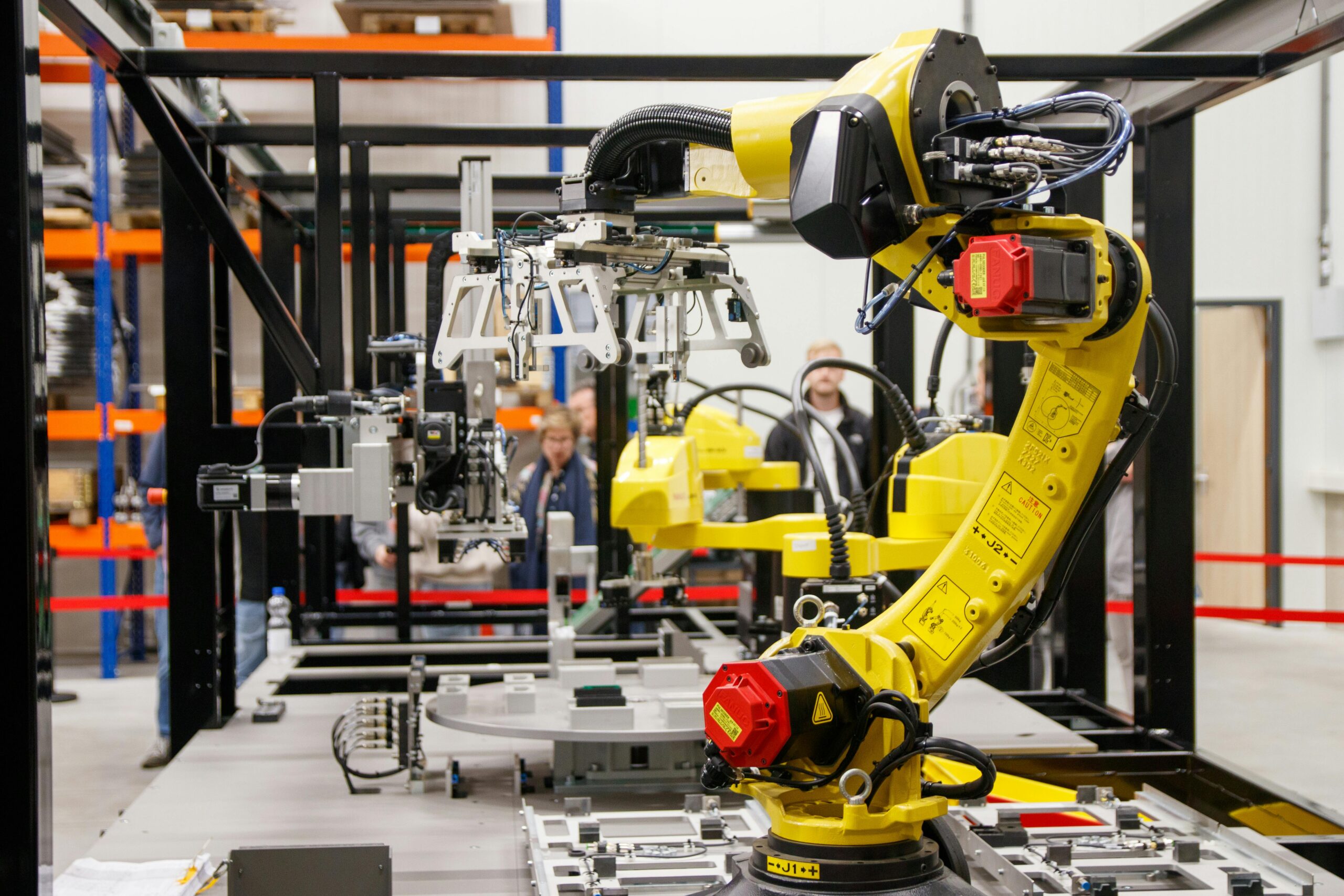
Many of those businesses are manufacturing companies that are on the frontlines of digital adoption. They shared examples of how they are adopting new technologies ranging from robotics to precision machining to AI and more. These businesses offer an important ground-level perspective on a broader national challenge: how to ensure workers and local businesses have the skills, support, and flexibility needed to adapt to technological change and share in its gains.
Insights from these businesses can help policymakers and advocates design flexible policies that equip workers and their employers to respond to the ongoing technological shifts in the US economy. Below, we describe key insights and policy implications associated with them.
If a business spends $1 million on a new robot, that tool often comes with some vendor-provided training on how to use it. But the training is often very brief. In some cases, expensive equipment then sits idle during a shift because not enough people are trained to use it safely, or the business doesn’t have a clear plan for training newly hired workers over time.
The businesses that are best-positioned to benefit from their capital investments are those that have fully thought through the skill-building element of new equipment purchases. They have allocated sufficient supervisory time and resources to ensure that their incumbent workforce builds the skills necessary to use new equipment. And they have worked with their Human Resources staff to ensure that the onboarding process for future employees will incorporate any necessary skill-building.
Leading businesses also know that they won’t achieve the full financial benefits of new technology unless workers themselves have meaningful opportunities to weigh in on how the tech will be incorporated. Recent research affirms that consulting workers about the adoption of new technology is associated with positive outcomes, including higher productivity.
Policy implication: Consider how policies that support small businesses in acquiring new technology can also incorporate a workforce focus as part of tech purchases. One example is the nonprofit Conexus Indiana.
Digital resilience includes being able to adapt when confronted with a novel digital tool, and to translate technology-related skills from one domain to another. While people can intuitively do this with simple tasks – such as logging into a new website and figuring out how to create a user account and password – more complex applications are not always as obvious.
Understanding which digital skills are transferable and how to apply them in a new context often requires people to engage in abstract thinking, use metacognitive skills, apply them via hands-on, experiential learning, and then participate in guided reflection. These are exactly the kind of activities that an experienced teacher can coach workers and learners to do.
More specifically, this kind of adaptability is something that adult education and Career Technical Education instructors are skilled in helping people develop. Businesses that have close partnerships with educational institutions are better positioned to help workers apply their existing skills to a new digital domain. For example, a community college might work with a local business to develop a customized training program that uses the principles of andragogy (the teaching of adults) to tap into workers’ intrinsic motivations and prior experiences to help them prepare for using new technology.
Policy implication: Investing in partnerships between businesses and education providers can ensure that educators’ expertise is available to inform digital upskilling initiatives.
On the surface, this might seem surprising. What do so-called “soft skills” have to do with robotics knowledge or software expertise? But technology products are implemented by human beings, and workers who have strong interpersonal skills are better equipped to work collaboratively with colleagues as they jointly adopt new tools and techniques.
On an individual level, copious prior research shows that the adoption of new technology tools depends heavily on psychological factors, not just whether people have acquired the technology skill itself. Emotions, attitudes, and information-seeking behaviors all influence when, why, and how a person chooses to use new technology.
When it comes to artificial intelligence tools specifically, human judgement and related interpersonal skills become even more important. Research is still in the early stages but suggests that AI productivity gains may be more likely to occur when digital tools are used to augment tasks carried out by a human.
Policy implication: Ensuring that workforce development policies are inclusive of interpersonal skills training, particularly for first-line supervisors, is key to supporting technology adoption.
One employer told us how he had come to realize that his new service technicians needed to have fluency with the most widely-used customer service software in the industry – and that workers’ lack of facility with the tool was otherwise costing his company time and revenue. He realized that it would be best if workers could gain experience with the actual software product in a low-stakes situation before they started work, rather than after he hired them.
He was able to convince the software vendor to make a “sandbox” (a functional version of the software that was not connected to any real-world customers or companies) available so that students could practice using it as part of their educational experience. Then, because he serves on an advisory committee for a local educational institution, he was able to make educators aware of the software resource so that they could incorporate it into their programs.
Policy implication: Explore ways for work-based learning and apprenticeship policies to explicitly include digital skills instruction and hands-on practice as part of the educational experience.
One employer described an elaborate in-house database that his company uses. The database allows training orders to be scheduled alongside work orders, so that a worker may be assigned to run parts for a work order in the morning, and then in the afternoon have a training module to complete.
Training modules include activities such as job shadowing, reading technical training manuals, and/or attending community college courses. The database allows the company to lay out individual learning paths for each worker and enables workers to see how the training they are receiving qualifies them for promotion and career advancement.
While the database was not originally designed to include AI tools, the worker who created the database is now being paid by the company to attend classes in AI innovation, and has begun to modify the database with additional features such as an AI chat function that can be used for searching and creating datasets. The company is actively planning his next career steps and how he can use his new knowledge to support their operations.
Policy implication: Efforts to support businesses in adopting AI technologies should be broad and flexible enough to encompass cases where companies want to upskill incumbent workers and/or add additional AI functionality to existing tools and processes.
Many of the employers that NSC spoke with frankly confessed that they were unfamiliar with some of the technology-related credentials they saw on jobseekers’ resumes, and unsure of how those credentials translated into real-world skills. This was true across industries, even among companies that identified themselves as being in the tech sector.
In the worst cases, this led to disregarding or minimizing the importance of credentials presented by job seekers. (This issue was also raised by workers themselves in separate research that NSC completed last year. In those cases, people pursued training because they were told it would help them find a job, only to discover that employers did not know or value the tech credentials they had earned.)
However, employers also described the circumstances that made them most likely to trust a credential:
On the latter point, workers didn’t need to have an elaborate spiel – only a brief sentence or two of context that highlighted the rigor and process of earning the credential and the skills associated with it.
Policy implication: Policymakers seeking to improve credential recognition and portability should also consider how to support educators and jobseekers in communicating the value of specific credentials.