Across the country, state workforce coalitions are navigating a moment of instability and political uncertainty. Federal funding cuts and freezes, SNAP and Medicaid rollbacks and work requirements, a slowing economy, rising inflation, and growing unemployment are already affecting millions of people. Meanwhile, additional cuts proposed through the budget process would further weaken the systems workers and employers rely on to prosper. With tight state budgets, loss of healthcare and safety net supports, and the likelihood of much more unknown ahead, states are being asked to do more with less. At the same time, state advocates are trying to determine how to capitalize on the opportunity created by Workforce Pell.
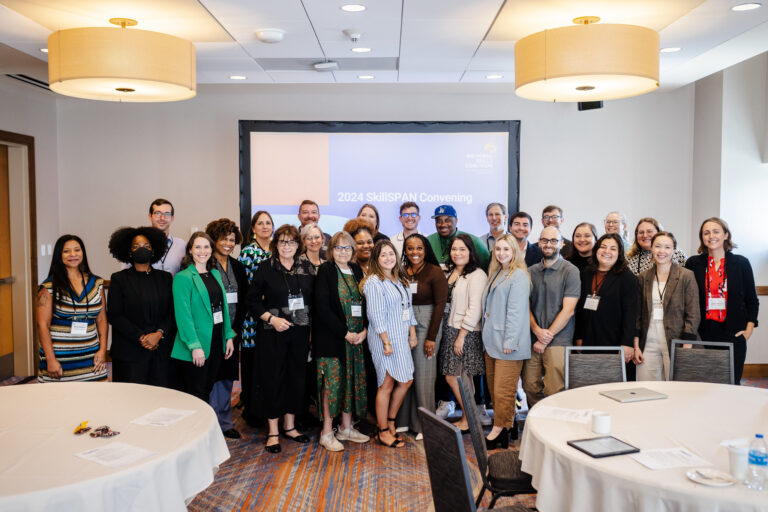
In this environment, the work of SkillSPAN is more vital than ever. That determination was front and center in Albuquerque NM last week, where SkillSPAN leads gathered to strengthen relationships through meaningful conversations, trust-building, and peer learning; explore workforce and political trends and align approaches that maximize our network’s impact. More than a routine convening, it was a call to action.
The session called “Holding the Line in 2026: Leading Workforce Advocacy Amid Instability” grounded leaders in the political realities ahead and how to respond. Coalition leaders talked through the stakes with their peers: budget cuts that will ripple through local economies, rollbacks to the supports that help people persist in education and training, and misinformation that attempts to undermine inclusive workforce policies. The challenge that SkillSPAN leaders addressed in the convening: recognizing the year it’s been while seizing the opportunity to strategize.
Many state SkillSPAN coalitions are already modeling how to press forward. Leaders dug into the fundamentals of advocacy – from framing and messaging to cross-sector organizing – that have helped coalitions advance outcomes for workers, families, and businesses in these uncertain times. Peer examples showed what has been possible despite instability:
“I came [into the convening] feeling really stressed, but I left feeling inspired because my problems are not my own. They’ve been kind of replicated throughout other places. And seeing how they were able to overcome them, it gives me hope that we [can] replicate that in Louisiana.” — Danielle Barringer, Louisiana
Next, the convening turned to the people most impacted by policy choices. Too often, systems are shaped without the perspectives of those most directly impacted, but SkillSPAN states are rewriting that approach. In a session entitled “Lifting Voices: Strategies for Centering Workers and Students in Policy Change,” participants heard concrete approaches for building advisory structures, sustaining grassroots leadership, and creating meaningful pathways for worker and student engagement. They heard from:
The session made one thing clear: communities are not asking to be included – they’re leading the work, and coalitions must make space for that leadership to shape state agendas.
“What I’m most excited about is some of our New Mexico partners got to be able to participate. They’re organizations that have been in the space providing services for a long time, but they’ve never been in this role of advocates and policy makers and lifting up voice of the state legislature. They’re all moving into that space. For them to be able to be a part of this and hear from other states and how they’re doing it, I think this is really going to be a launching point to what the group is able to accomplish moving forward.” — Simon Lopez, New Mexico
The final day was about action. During “Strengthening Our Coalitions: Challenges, Opportunities, and Areas for Growth,” states mapped their organizational structures and named gaps — because “states need all hands-on deck.”
The convening culminated in “Turning Strategies into Action” — dedicated time for states to create near-term plans for progress. They identified:
Every state left with a clearer path — and a stronger network to help them along.
This convening was rooted in a shared belief: that every person in America should be guaranteed access to skills, good jobs, and economic prosperity. Federal decisions can either reinforce that promise — or roll it back. But SkillSPAN leaders are making sure progress will continue on the state level. They are championing policies that keep workers moving forward, ensure employers can grow, and strengthen state economies from the bottom up.