
TL;DR: This budget recycles last year’s failed proposals, pairing workforce rhetoric (including America’s Talent Strategy and apprenticeship goals) with significant cuts, program eliminations, and risky consolidations that would weaken the very system on which workers and businesses rely.
Each year, the administration releases the President’s Budget Request (PBR), a document that signals the administration’s funding priorities for the coming fiscal year. While the PBR kicks off the congressional appropriations process, it is just a proposal for Congress to consider and will not become law in its entirety. That said, the ideas often gain traction elsewhere.
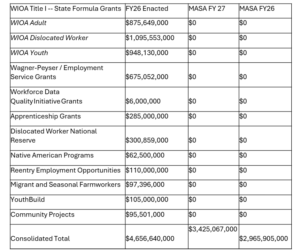
If the MASA initiative sounds familiar, it’s because it is. The administration is again proposing to consolidate 11 programs spending into a block grant called Make America Skilled Again (see chart below for breakdown).
At $3.425 billion, the administration’s MASA proposal cuts more than $1.2 billion from current funding levels. While this is slightly higher than last year’s proposal, it still falls short of current funding.
The proposal would also require 10% of state funding from MASA to be used for apprenticeships along with additional set-asides for targeted apprenticeship investments led by DoL (3%), and performance accountability (.75%). While these set-asides would increase apprenticeship funding, they come at the cost of other key workforce programs. Existing funding already supports apprenticeship at similar levels and fills important training and supportive services gaps that apprenticeship funding does not.
The proposal represents a solution to a real problem in current policy – education, workforce, human service and economic development systems and spending are often siloed or time consuming to braid together.
Ultimately, however, consolidation erodes programs designed to serve specific populations, especially workers with barriers to employment like Opportunity Youth, justice-impacted, and workers of color. And, while the administration frames this proposal as giving states more flexibility, less funding means less flexibility, not more. States have already been asked to do more with less over the past 25 years of declining investments in skills training. At the same time, the changing economy and technological advancements are increasing demand for training, retraining, and upskilling. States are already struggling to meet demand, and further cuts will strain the workforce system even more. The result: fewer workers can access training, and employers will struggle to find the skilled workers they need.
Beyond the cuts made by the Make America Skilled Again proposal, the administration proposes additional harmful cuts across the Department of Labor. The Job Corps’ budget is slashed by 90%, like last year, effectively winding the program down. The Senior Community Service Employment Program, which provides skills training opportunities to older workers, is cut entirely. These cuts eliminate training opportunities for younger and older workers, reducing options for the communities these programs serve.
The proposed cuts across the department of Labor will significantly reduce the workforce system’s ability to meet the needs of workers and employers.
Key workforce programs moved from Dept of Education to Dept of Labor: The President proposes transferring Career and Technical Education (CTE) programs from the Department of Education to the Department of Labor – a move the administration has pursued this since last summer which has created confusion and slowed previous years’ investments from reaching practitioners and students.
Restricts Career and Technical Education funding for k-12 school only: The budget would limit CTE State Grants exclusively to support middle and high school students. While ensuring young students are exposed to a full range of careers is important, nearly every state splits their CTE state grant between k-12 and post-secondary systems. Limiting funds to K-12 disrupts the integration of K-12 and post-secondary pathways and ignores the vast number of adults who are un/underemployed and could benefit from further CTE training.
Elimination of key programs: The President proposes eliminating Adult Education programs, gutting roughly $729 million in funding. The administration claims that these programs “inappropriately incentivize illegal immigration,” which is dangerous and false rhetoric, not grounded in the realities of working people. Adult education programs help both US-born and immigrant adults to build crucial skills, increase their earnings, and enter into career paths, including those related to Career Technical Education and apprenticeship.
Adult education boosts long-term earnings and provides a pathway to higher education, apprenticeship, and good jobs. Eliminating these programs is economically counterproductive, undermining the administration’s own goal of reaching 1 million apprenticeships.
Other proposed funding cuts: The administration further proposed cuts to key post-secondary funding, such as grants to support Minority-Serving Institutions, which provide an important post-secondary option for students and workers of color, and the Fund for the Improvement of Postsecondary Education (FIPSE), which partners often use to help meet students’ basic needs. FIPSE cuts in particular are baffling, given that the administration just recently awarded FIPSE grants, with a focus on supporting Workforce Pell implementation.
Recognizes the importance of the Pell Grant program: The Budget provides $33 billion for Federal Pell Grants, which support low-income students pursuing post-secondary education. This increase addresses the Pell Grant shortfall – where more students were able eligible to receive a Pell grant than Congress had appropriated funding for – and maintains the maximum award amount of $7,395.
This is especially important as the Workforce Pell program is set to begin later this summer, which will allow those who qualify for a Pell grant to receive funding for shorter, industry aligned workforce programs. Without addressing the shortfall, that expansion could have been undermined before it even launches.
It should also be noted that Workforce Pell represents a very small share of Pell program costs. Estimates for the cost of the Workforce Pell program are between 2 – 3 billion over the next ten years, less than 1% of total Pell Grant funding.
This is a notable change from last year’s proposal, which would have cut Pell Grant funding by $1 billion, and reduced the maximum Pell Grant award by $1685. This is a strong indication that the administration has heard from the field that Pell Grants are an important source of aid for low-income students to continue their careers that meet in-demand hiring needs of local businesses.
Ultimately, Congress needs to pass dedicated and substantial mandatory investment in the Pell Grant program – so low-income students don’t need to wait in limbo to see if there will be a potential cut to their grant maximum or eligibility.
As we often say at NSC, basic needs are workforce needs. Access to supports like adequate nutrition, affordable childcare, and reliable transportation are often among the most important factors in whether a person can enter and complete a workforce training program and find lasting employment. Unfortunately, this budget moves in the wrong direction on all these fronts.
Even before this budget proposal, last year’s reconciliation package made access to basic supports harder by cutting Medicaid and SNAP and forcing states to fill budget gaps left by those cuts. This budget goes even further – reducing funding for basic needs programs across the board.
Specifically, the Department of Health and Human Services (DHHS) would face a $16.5 billion cut, consolidating or cutting over two dozen divisions, including departments that help address youth violence prevention.
As with last year’s proposal, funding for the Low-Income Home Energy Assistance Program (LIHEAP), which helps low-income families afford heating and cooling services, and the Community Services Block Grant, which helps address poverty are both eliminated as is the Child Care Access Means Parents in School (CCAMPIS) under the Department of Education which supports child care for parents in post-secondary education. Together, these programs provide housing, energy, childcare, and nutrition supports that provide families financial stability.
At the same time, the budget cuts food nutrition programs including a $550 million cut to Women, Infants and Children (WIC)grants to states. Even with a $350 million increase to the WIC contingency fund, this results in a net cut to the program of $200 million. SNAP faces an even steeper reduction, with a $6.244 billion cut driven by the state administration cost shifts established in last year’s reconciliation package. States are already absorbing these costs, which may reduce access to nutrition benefits for the families who need them most. Losing access to food, housing assistance, childcare, or energy support does not make someone more able to work or participate in training; it pushes them deeper into poverty.
One small bright spot is that SNAP Employment and Training receives a small $16.7 million bump to 50/50 funds, uncapped funds where states and the federal government split costs equally for participant costs in training and education programs including wrap around supports. However, states will be limited in their ability to expand these programs due to other costs that they are facing. And with 100% federally reimbursable SNAP E&T funds kept level, the overall investment in workforce-connected nutrition support falls far short of what is needed.
The President’s budget proposes to eliminate key programs and agencies at the Department of Commerce that are designed to support employers by stimulating economic growth and job creation including supporting skills training. This runs counter to the Trump Administration’s stated goal to grow the economy by supporting workers and employers, particularly manufacturers.
Among the agencies slated for closure is the Economic Development Administration (EDA) which provides grants to support distressed communities and has been used by the administration to fund workforce initiatives supporting its AI action plan. EDA programs support regional job creation, industry-driven training, and inclusive economic growth, and help build partnerships that help serve workers facing barriers to employment. Many small and mid-sized businesses depend on EDA’s programs to support workforce strategies and strengthen local economic environments that drive growth.
At the same time, funding for the Hollings Manufacturing Extension Partnership a long-standing program that assists small and mid-sized manufacturers to modernize operations and strengthen their workforce is also proposed for elimination for the second year. Taken together, these cuts would eliminate key programs that support employers’ workforce development needs.
These proposed cuts undermine the conditions employers need to expand operations, increase productivity, and create new jobs – outcomes that benefit workers, employers, and the economy as a whole.
We see a similar contradiction between the administration’s approach to AI and programs that support access to digital skills. The Trump Administration has recognized that the rapid rise of AI presents both a significant opportunity for job creation and a serious disruption requiring a national response. It has put forth numerous frameworks and resources to respond to the growth of AI. And yet, the administration proposes to eliminate $2.2 billion in Digital Equity program funding that supports broadband internet access, devices like computers, and digital skills training. Already 92% of jobs require digital skills, yet one third of workers don’t have the foundational skills necessary to enter and thrive in today’s jobs. With the growing deployment of AI, the demand for workers with foundational and occupational digital skills is likely to continue to grow and cutting this funding reduces resources, tools, and training that will be critical to helping workers build those skills.
While this budget will not become law in its entirety, the priorities it signals are deeply troubling. Funding for workforce programs has been on the decline for 25 years and for the past alone, actual funding levels for workforce programs have remained flat, forcing the system to do more with less as costs rise. These declines have occurred across multiple congresses and administrations and a potential shift in party control in one or both chambers of congress after the midterm elections may not dramatically change that picture either. Most proposals will still require bipartisan support and presidential buy-in. That’s why advocacy remains critical.
NSC will be watching closely as Congress begins the appropriations process and will keep our network informed as that work unfolds. NSC will continue advocating for the investments that workers and employers need to succeed in a changing economy.