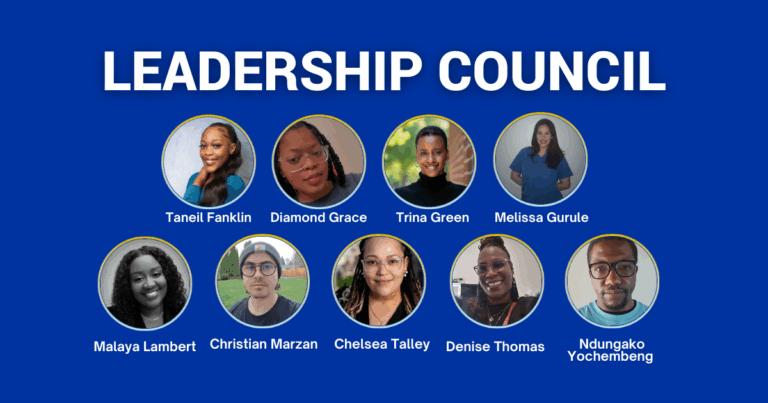
Malaya Lambert didn’t take a straight path into healthcare – or into advocacy. A mom, a former college athlete, and now a patient care technician, Malaya has navigated interrupted education, financial barriers, and career pivots. Today, as a member of NSC’s Voices for Skills Leadership Council, she’s using those experiences to speak up for other workers and learners who are trying to build better lives.
NSC’s Nicky Coolberth spoke with Malaya about her journey, what she’s learned along the way, and why she believes more people need access to “learn and earn” opportunities.
Malaya: I’m originally from New York. I went to Howard University in 2011 on a full tuition scholarship studying sports medicine – and I was the starting catcher on the softball team. Later, I decided I wanted to be a lawyer. But then, life happened. It was a lot of heartbreak. I ended up leaving school and my education was interrupted for a while. Over the next couple of years, I had a daughter, and I went to school locally in New York, and tried, with the help of my parents, to figure things out.
Later, I went back to Howard, but then the pandemic hit and everything really went haywire. I left campus and immediately got into a car accident – it was just a lot at once.
I had started my Certified Medical Assistant certification at College of Staten Island. But, when I needed to work, I ended up working at VNS Health as a care management navigator. That was really my entry into healthcare. Basically, I was helping people on Medicare get what they needed – for instance, did they have somewhere safe to live, were they getting groceries and eating well, did they have needed medical devices (like glucose monitors), home care, all of it.
I really liked helping people maintain their quality of life, but I wanted to be more hands-on, more clinical. My personality is such that I knew I’d be good at it. I care about people, and I’m good with my hands, and I picked up first aid very well. I was finally able to complete my CMA certification using an Individual Training Grant from New York City.
Once I got my certification, I worked at Summit Health, in Nephrology, supporting people with Kidney problems and helping to explain things to patients in a way they could understand. I could really lean in on my empathy. For instance, there’s a lot of terminology and clinical language that can cause people anxiety. Doctors would talk about results of a KT/V blood test (which is test to determine how clean a patient’s blood is ) – but I could just say, “Sir, you’ll need stop eating this food or drinking this tea because it’s shooting your blood pressure through the roof!”
Now I work as a patient care technician at DaVita, helping patients with dialysis. I still manage a lot of communication between patients and providers. DaVita dialysis centers are everywhere, and I make sure to tell all my patients you can still have a life, travel, and see your family and have a great quality of life.
Malaya: Any opportunity to advocate for an underserved community, I want to be part of that. Maybe I can say something in a way that makes change happen.
My story isn’t unique—and that’s kind of the point. You hear a lot about people who are completely underserved, but there are also people like me. I was a gifted kid. I did most things right. But then life happened. I wasn’t destitute, but I needed help getting my professional life back on track.
There are so many people in my community just like that. People who are working hard, who are trying, having successes, but who still need support.
Malaya: The biggest one for me is access – especially to “learn and earn” programs.
I’m a single mom. I can’t imagine how different my life would have been if I could have gotten my certification while earning a paycheck. I couldn’t afford to pay for training out of pocket. So, I had to pause my education multiple times because I was working, going to school, and trying to manage everything. It was stressful in a way that’s hard to even put into words – missing out on income, trying to keep up, traveling for classes. It was chaotic.
And the thing is, earn-and-learn opportunities do exist—but you’re not going to stumble into them. Unless you’re extraordinarily tenacious, you’re not going to find them. There’s just no clear access to information.
I did well in my program, but I didn’t fully experience it the way it was intended. My attention was divided. I had to put in extra time, ask for help, go back over things I didn’t get to fully master. Then, when I got into my first job, it was a little like being tossed into the water and I needed to figure out how to swim right away.
A learn-and-earn opportunity would have changed everything. I would have been able to focus, to really absorb the training, without that constant financial stress.
Malaya: It was probably the coolest thing I’ve ever done in my life.
On the first day, we had a session where we were breaking down what we were going to say when we got up to Capitol Hill – and it was exactly what my brain needed. At first, I was overwhelmed. Like, wait—we’re talking to people in Congress? I didn’t even know that was something people like me could do.
But what really stood out was seeing other people with stories like mine. It was so validating to know your lived experience isn’t an anomaly.
I was raised with this idea of “each one, teach one.” And that’s what that first session where we were preparing felt like. Everyone was looking out not just for themselves, but for the people coming after them. The energy in the room was like – we can actually make things better.
That was one of the most moving experiences I’ve had as an adult.
Malaya: Honestly, I didn’t know what to expect. I thought it was going to be really stiff and formal – and that’s not really my vibe. I can be very unserious.
But the way the summit prepared us helped a lot. The icebreakers, the conversations we had, they made everything feel more human and brought out our common interests. I was the only student from New York. And I’ve found that people have assumptions about people from the city. But nobody made fun of the way I say, “coffee.”
What I learned is that there are a lot of things ordinary citizens can do. We can make appointments, we can talk to our representatives, and we can ask them to take actions that help people. I had no idea that was even possible.
Senator Schumer’s office was a sobering experience. They were so accommodating, and ingratiating, but they were so REAL about the challenges people like me are facing and that they are facing as they try to make change. I learned so much in just a short time visiting that office. Something else that surprised me: even in offices where I expected pushback, people were receptive. They listened. They were interested in what I had to say.
It made me realize that a lot of the divide is misunderstanding. People focus on differences, but we’re actually more similar than we think. And when you share your story in a way that’s human and transparent, it can open doors. Workforce issues are something people across the board can agree on – people want to work, and that’s good for the country. That creates space for real conversation.
Malaya: Keep an open mind. Go in without assumptions. I’m a very optimistic person, probably annoyingly so, but it helps. It cuts the tension. It opens people up. You might think you know how it’s going to go, but it could be completely different. So go in expecting the best.
Malaya: I want to learn how to be the best possible advocate for people and how to empower others to advocate for themselves. What I realized at the summit is that people have more power than they think. You might not change someone’s mind overnight, but you can be a voice they remember. You can be that little voice in their ear.
I’ve felt really small sometimes, like my voice didn’t matter in the bigger picture. But that experience made me feel less hopeless. It showed me there are people who care just as much as I do.
Now I want to help other people feel that same confidence—that they have a voice, that they can take action, that they can shape their own path.
Because we’re more powerful than we think.